
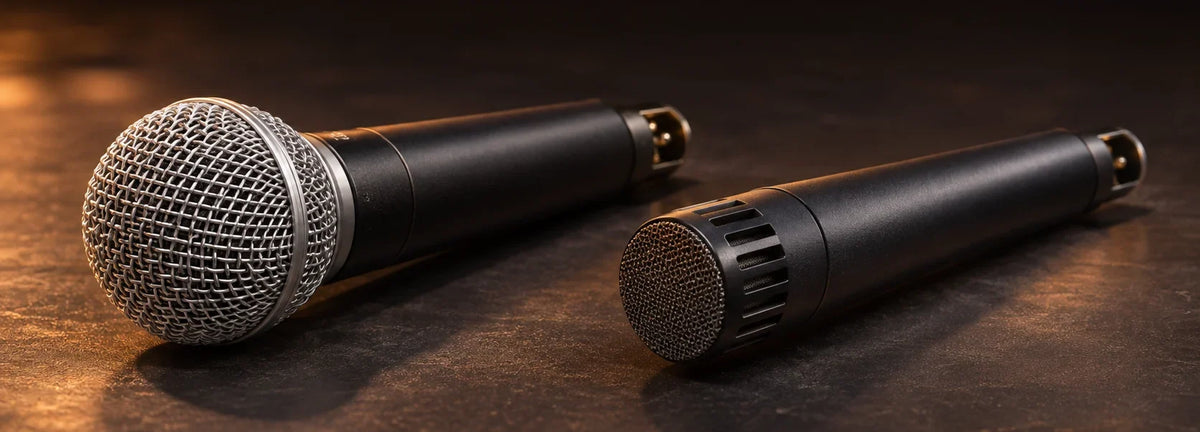
The Shure SM58 and SM57 are both cardioid dynamic microphones, and Shure says they are built on the same cartridge design. The difference is the grille. The SM58 has a round steel mesh grille with a pop filter built in, so it is the one to sing, MC or give a toast into. The SM57 has a small, flat grille that sits close to the capsule, so it gets right up against a guitar amp, a snare drum or a horn. One mic for vocals: buy the SM58. One mic for instruments: buy the SM57.
Specs below come from Shure's spec sheets and product pages. Prices are what we charge in November 2026 and they move, so check the product page before you decide.
Which one should you buy?
- Singing, karaoke, MCing over a DJ set, speeches: SM58 (about $89). The built-in pop filter handles breath and wind, the ball grille protects the capsule when the mic gets dropped, and the wider body is easier to hold. The SM58S (about $99) is the same mic with an on/off switch, which is handy when the mic sits on the DJ table between announcements.
- Guitar and bass amps, snare, toms, horns: SM57 (about $89). The smaller head goes closer to the source. Shure says the shorter distance from grille to diaphragm gives a stronger proximity effect up close and slightly more output above 5 kHz, which helps an instrument cut through. Miking a snare and an amp? The SM57 2-pack is about $190.
- A band, church or school that does both: one of each. They cost the same, so put the SM58 on vocals and the SM57 on the guitar amp or snare.

The SM58 is the one you hold and talk into. The SM57 goes up close to amps and drums.
SM58 vs SM57: specs side by side
| Shure SM58 | Shure SM57 | |
|---|---|---|
| Shure calls it | Vocal microphone | Instrument microphone |
| Type | Dynamic (moving coil), cardioid | Dynamic, cardioid |
| Frequency response | 50 to 15,000 Hz | 40 to 15,000 Hz |
| Tuning, in Shure's words | Brightened midrange and bass rolloff, tailored for vocals | Contoured, with a presence rise |
| Sensitivity at 1 kHz | -54.5 dBV/Pa (1.85 mV) | -56.0 dBV/Pa (1.6 mV) |
| Rated impedance | 150 ohms (300 ohms actual) | 150 ohms (310 ohms actual) |
| Grille | Spherical steel mesh with built-in wind and pop filter | Polycarbonate grille with a stainless steel screen |
| Pop filter | Built in | None built in. Shure's A2WS locking windscreen is the add-on |
| Length | 6 3/8 in (162 mm) | 6 3/16 in (157 mm) |
| Widest point | 2 in (51 mm) | 1 1/4 in (32 mm) |
| Weight | 10.5 oz (298 g) | 10 oz (284 g) |
| Connector | 3-pin male XLR | 3-pin male XLR |
| In the box | A25D swivel stand adapter, storage bag | A25D swivel stand adapter, storage bag |
| Replacement grille | RK143G | RK244G |
| Our price | $89 (SM58-LC), $99 (SM58S with switch) | $89 (SM57-LC) |
Prices as of November 2026.

Are the SM58 and SM57 the same mic?
Close, but not the same. Shure says the two are based on the same cartridge design and that the main difference is the grille. That grille is what changes how each one sounds and what it is good at.
The SM58's ball grille holds a pop filter in front of the capsule, which keeps breath and P and B sounds out of the speakers. The SM57's grille is built into the cartridge assembly, so the diaphragm sits closer to whatever you point it at. Shure says that gives the SM57 a more pronounced proximity effect (more low end as you get close) and slightly higher output above 5 kHz.

Why they sound different: the SM58's ball grille holds a pop filter and keeps the capsule back. The SM57's capsule sits right behind the screen. Illustration, not to scale.
On paper the SM57's rated range starts lower, at 40 Hz against 50 Hz, and the SM58 is rated about 1.5 dB more sensitive. In practice the grille and how close you get matter far more than either of those lines.
Is the SM57 or SM58 better for vocals?
The SM58, for most people. The pop filter handles plosives and outdoor wind, the ball grille keeps lips off the capsule, and Shure tuned it for vocals with a brightened midrange and bass rolloff.
The SM57 is not wrong for vocals. Shure points out it has often been used on them, because its proximity effect and lift above 5 kHz suit some voices. If you try it, add a windscreen, since the SM57 has no pop filter of its own.
Which is better for a DJ to talk on?
The SM58. You are holding it, talking close and often outdoors or near a dance floor, which is exactly what the pop filter and the ball grille are for. If the mic lives on the table, the SM58S on/off switch saves you a trip to the mixer to kill a channel.
Check your connection before the gig. Both mics have an XLR output. A mixer or powered speaker with an XLR input takes a regular XLR mic cable. Many DJ controllers, like the Pioneer DDJ-FLX4, have a 1/4-inch mic jack instead, so you need an XLR to 1/4-inch cable.

Pick the cable by what you plug into: XLR to 1/4-inch for most DJ controllers, XLR to XLR for mixers and powered speakers.
Want to walk the room? Shure puts the SM58 capsule on its wireless handhelds, including the BLX24/SM58 (about $329). See all Shure wireless microphones.
Which is better for guitar amps and drums?
The SM57. Shure tunes it for amplified and acoustic instruments and lists guitar and bass amps, saxophone, trumpet and drums as its jobs. The smaller head fits between drums and up against an amp's grille cloth where a ball grille would not. Shure also describes it as extremely durable under the heaviest use, which matters on a snare.
The SM58 will work on an amp in a pinch. Shure's own answer is that it comes down to what works for your application. The SM57 is simply the better fit when the mic goes close.

Can you record with an SM58 or SM57?
Yes. Shure lists studio recording for both. They are dynamic mics, so they do not need phantom power. To record into a computer you need an audio interface with an XLR input. If you are deciding between this and a USB mic for a podcast, read USB vs XLR microphones for podcasting first.
How long do they last, and what can you replace?
Both use a pneumatic shock mount to cut handling noise, and Shure sells the parts that take the beating separately:
- SM58 grille: the Shure RK143G (about $11) fits wired and wireless SM58s. Shure lists the R59 as the SM58's replacement cartridge.
- SM57 grille: Shure's part is the RK244G.
- Stand adapter: both ship with the A25D. A spare A25D clip is about $9 and worth keeping in the gig bag.
What else will you need?
- A cable. Neither the SM58-LC nor the SM57-LC includes one. Get an XLR cable for mixers and speakers, or an XLR to 1/4-inch cable for most DJ controllers.
- Something to plug into. A DJ controller or mixer with a mic input, a powered speaker with an XLR input, or an audio interface to record.
- A stand, if you will not be holding it.
Still shopping around? See our top microphones under $100, all Shure dynamic mics, or our Shure SM7B guide for a broadcast-style studio mic. Not sure what a term means? The pro audio terms glossary explains XLR, phantom power and more. Or call us at 1-800-700-4542 and we will help you pick.
Common questions
Is the SM58 the same as the SM57?
Not quite. Shure says they share the same cartridge design, and the main difference is the grille. The SM58 has a ball grille with a built-in pop filter for vocals. The SM57 has a smaller grille that puts the capsule closer to instruments.
Is the SM57 or SM58 better for vocals?
The SM58 for most singers and speakers, because of its built-in pop filter. The SM57 can work on vocals too, with a windscreen added.
Which is better for a DJ mic?
The SM58, or the SM58S if you want an on/off switch. Many DJ controllers have a 1/4-inch mic jack, so you will need an XLR to 1/4-inch cable.
Do the SM58 and SM57 need phantom power?
No. Both are dynamic microphones and do not need phantom power.
What is the difference between the SM58-LC, SM58S and SM58-CN?
Same microphone, different extras. The SM58-LC has no switch and no cable. The SM58S adds an on/off switch. The SM58-CN comes with an XLR cable.
Can I use an SM58 on a guitar amp?
Yes. Shure says it comes down to what works for your application. The SM57 is the usual pick because its smaller head gets closer to the speaker.