
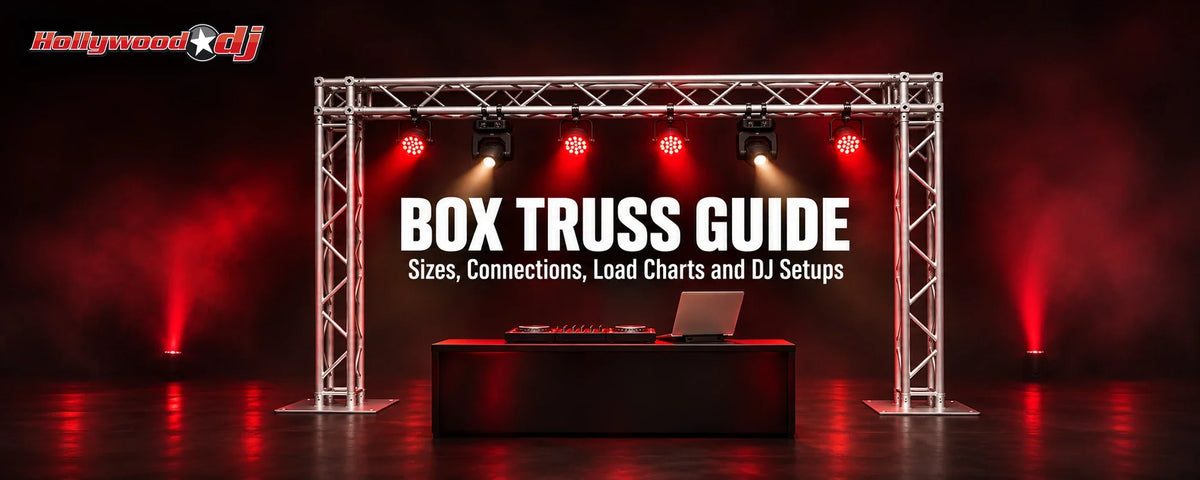
Quick answer: Box truss is square aluminum truss with four main tubes (chords), used to hold up lights, speakers, LED walls and scenery. For DJs and events, the two families that matter are F34-class conical truss (11.42" / 290 mm square, joined with cones and pins) and 12" or 20.5" bolt-plate box truss (joined with Grade 8 bolts). They look alike but do not connect to each other, so identify a system by its connection, not its size label. How much a span holds depends on its length and where the weight hangs, and it is only known from the load chart published by the maker of that exact truss.
This guide is for mobile DJs, event companies, venues, schools and churches buying or setting up truss. It covers the profiles and what the model numbers mean, how the two connection systems differ, how to read a real manufacturer load chart (with the numbers), the common DJ setups and the parts each one needs, and the checks to run before every show. Our Los Angeles team sells Global Truss, Show Solutions, ProX and Galaxy Stage truss, and this guide answers the questions we hear most.
Safety note: This guide explains how truss works so you can buy the right gear and ask the right questions. It is not engineering, and Hollywood DJ does not design or certify rigs. Truss should be assembled by people trained on that system. Flown (hung) truss, anything over an audience, outdoor structures and any rig near a chart limit should be planned by a qualified rigger and checked by a structural engineer.
What is box truss?
Truss is a lightweight beam made of welded aluminum tubes. The long tubes are the chords. The short tubes that zig-zag between them are the diagonals (or braces). Each place a diagonal meets a chord is a panel point or node, and that is where loads should hang. "Box truss" and "square truss" both mean a profile with four chords in a square. You will also see truss with one, two or three chords.
Truss profiles at a glance
| Profile | Chords | What it is good for | Shop |
|---|---|---|---|
| F31 single tube | 1 | Short pipe runs, banners, connecting pieces. Very low load. | F31 segments |
| F32 ladder (I-beam) | 2 | Flat walls, facades, signage, light-duty runs. Strong in one direction only, and its rating depends on how it is braced. | F32 segments |
| F33 triangle | 3 | Portable lighting rigs, totems, arches. Lighter than square. | Triangle truss |
| F34 square (11.42") | 4 | The all-purpose DJ and event truss: goalposts, totems, booths, LED walls, overhead lighting. | F34 segments |
| 12" bolt-plate box | 4 | Film and staging frames, ground support, rigs that stay up for days. | Box truss |
| 20.5" bolt-plate box | 4 | Longer spans and heavier loads, such as large lighting grids. Big structures built from it must be engineered. | Box truss |
What do F31, F32, F33 and F34 mean?
Global Truss's F-series names are now used by many brands. The second digit is the number of chords: F31 is one tube, F32 is two, F33 is three, F34 is four. On Global Truss F34, the chords are 1.97" (50 mm) tubes with a 0.08" (2 mm) wall, braced by 0.79" (20 mm) diagonals, in 6082-T6 aluminum, and the profile measures 11.42" (290 mm) overall (source: Global Truss F34 Load Span Table, 2026). Other names you will see:
- F24, F23, F14: smaller, lighter-duty profiles with thinner tubes, for displays and light fixtures. They do not connect to F34.
- Heavy-wall versions (F34P, DT34P, DT44P): 0.12" (3 mm) wall tube. Heavier wall does not mean higher ratings in every load case, so check the chart for that exact model. Global Truss's DT44P is a larger 15.75" (400 mm) heavy-duty square.
- DT36 and DT46: Global Truss heavy-duty six-chord truss for large spans.
- Load-rated equivalents: Show Solutions SCT290, ProX XT-SQ, Galaxy Stage GS34 and Chauvet Trusst CT290 are 11.42" (290 mm) conical square truss in the F34 class, each with its own chart.
Watch for display-grade truss. Some F34-size truss is made with a thinner wall for displays and is not for carrying rated loads. ProX K-Truss, for example, is sold for displays and non-load-bearing systems, with a 1.5 mm wall. It fits F34 in size only. Never hang fixtures from display-grade truss, never mix it into a load-bearing span, and never read its capacity off a standard 2 mm chart.
Is F34 truss the same as 12-inch box truss?
No. This is the mix-up we see most. F34-class truss is 11.42" (290 mm) and joins with conical couplers. Bolt-plate box truss such as Show Solutions ST-1212, Galaxy Stage GS-12 and ProX BoltX is 12" and joins with flat plates and four bolts. To add to the confusion, many listings (including some of ours) call F34-class conical truss "12-inch" because it is close to a foot wide. Identify the system by its connection, cones or plates, and buy every corner, base plate and junction block for that system.
Conical (spigot) vs. bolt-plate truss
The connection is the biggest practical difference between truss systems. It decides how fast you set up, what tools you carry, and which parts fit together.


| Conical coupler (spigot) | Bolt plate | |
|---|---|---|
| How it joins | Each chord ends in a cone. At each chord, a coupler takes two tapered pins (spigots), each held by a safety clip. A four-chord F34 joint uses 4 couplers, 8 pins and 8 clips. | Each end has a flat aluminum plate. Two plates are bolted face to face with four Grade 8 bolts, nuts and washers. |
| Tools | A mallet to seat pins. Chauvet's Trusst guide calls for a rubber mallet if needed. | Hand wrenches, such as a rigging wrench. Tighten as the maker instructs. |
| Setup speed | Fast. A DJ goalpost goes together quickly. | Slower. Four bolts per joint. |
| Common sizes | F31 to F34 (11.42"), F44P and the heavy DT lines. | 12" x 12" and 20.5" x 20.5". |
| Typical use | Mobile DJs, events, exhibit booths, touring lighting, LED walls. | US film and TV, staging, installs, longer-term ground support. |
| Small parts to stock | Spare pins and clips, half conicals for base plates. | Grade 8 bolt sets, half-moon washers. |
| HDJ lines | Global Truss, Show Solutions SCT290, ProX XT F34, Galaxy GS34 | Show Solutions ST-1212 and ST-2020, ProX BoltX, Galaxy GS-12 and GS-20 |
A third style, the fork end (also called fork and pin), uses a male tongue that slides into a female fork and is held by a pin. It is common in Europe but rare in US DJ and event gear.
Can I mix truss brands?
Many brands' F34-class conical truss will physically connect, but a load chart is only valid for the truss it was calculated for. ProX's F34 chart says it is calculated for ProX XT-SQ truss only and is void if mixed with other brands. Global Truss says the tapered pins it supplies must be used. If you join two different models, even from one brand, you can only count on the lower of the two charts at your span and load case. Our rule: one brand and one model per span, with the pins, couplers and plates from the same maker.
Truss sizes, lengths and weights
Conical truss is made in metric lengths and usually listed in feet as well. Bolt-plate truss is made in feet. The lengths you will see most:
| System | Common straight lengths |
|---|---|
| F34-class conical | 0.82 ft (0.25 m), 1.64 ft (0.5 m), 3.28 ft (1 m), 4.92 ft (1.5 m), 6.56 ft (2 m), 8.2 ft (2.5 m), 9.84 ft (3 m), 11.48 ft (3.5 m), 13.12 ft (4 m) |
| 12" bolt plate | 2.5 ft, 3 ft, 5 ft, 8 ft, 10 ft |
| 20.5" bolt plate | 4 ft, 10 ft and others |
Shorter pieces cost more per foot but give you more layouts. Browse segments 5 ft and under or 9 ft and 10 ft segments.
How much does box truss weigh?
F34-class segments of 6.5 ft and longer weigh roughly 4 lb per foot. Short pieces weigh more per foot because the end connections are a bigger share of the weight. Manufacturer figures:
| Segment | Length | Weight | Source |
|---|---|---|---|
| Chauvet Trusst CT290 | 3.28 ft (1 m) | 15.87 lb (7.2 kg) | Chauvet product sheet |
| Chauvet Trusst CT290 | 6.56 ft (2 m) | 26.45 lb (12 kg) | Chauvet product sheet |
| Global Truss F34 SQ-4112 | 6.56 ft (2 m) | 29 lb (13.17 kg) | Global Truss product page |
| Chauvet Trusst CT290 | 9.84 ft (3 m) | 38.58 lb (17.5 kg) | Chauvet product sheet |
| Global Truss F34 SQ-4114 | 9.84 ft (3 m) | 40 lb (18.16 kg) | Global Truss product page |
| Global Truss F34 SQ-4115 | 11.48 ft (3.5 m) | 45 lb (20.43 kg) | Global Truss product page |
Add the weight of corners, base plates and hardware when you plan transport and when you check stand ratings. Long segments and steel base plates often ship by freight.
How to read a truss load chart
Most truss makers publish a load chart (also called a load table or span table) for each truss model. It tells you how much weight a straight span can hold when it is supported only at its two ends, for a given span length and a given load position. If your truss has no published chart, get one from the maker before you hang anything from it. Longer spans hold dramatically less, and where the weight hangs matters just as much.
- UDL (uniformly distributed load): weight spread evenly across the entire span, like a drape. Given per foot (lb/ft), per meter, or as a total, depending on the chart. Check the units. A row of fixtures is a set of point loads, not a UDL.
- CPL (center point load): one load at mid-span, like a mirror ball.
- TPL (third point load): two equal loads, each one third of the way in from an end.
- QPL (quarter point load): three equal loads at the quarter points.
- FPL (fifth point load): four equal loads at the fifth points. Some charts list it.
- Deflection: how far the span bends at the rated load, in inches. Some charts cap deflection at the span divided by 180 (written L/180).
Charts do not always say whether TPL, QPL and FPL figures are the load at each point or the total for all points. Unless the maker states otherwise, treat the figure as the total. Reading a total as a per-point figure would overload the span two to four times over.
The load cases are alternatives, not a menu. You cannot hang the full CPL and the full UDL on the same span. A chart also covers only the positions it shows: a load placed off center puts more of the weight on the nearer support and its stand.
A real F34 load chart, explained
Here is an excerpt from Global Truss's 2026 F34 load span table, reviewed and stamped by a licensed professional engineer. It references ANSI E1.2-2021, the ESTA standard for aluminum truss and towers, among other codes. Global Truss prints three versions of the table: one limited by strength and L/180 deflection, one by strength only, and one by strength only reduced by 0.85 per ANSI E1.2. The two you would plan from are the L/180 table and the ANSI-reduced table. Neither one is always lower. The table below shows the lower of those two printed values in every cell. Cells marked † come from the L/180 table; the rest come from the ANSI-reduced table.
| Span | UDL (lb per ft) |
CPL (lb) |
TPL (lb) |
QPL (lb) |
|---|---|---|---|---|
| 6.56 ft (2 m) | 298 | 1,700 | 850 | 595 |
| 9.84 ft (3 m) | 217 | 1,679 | 842 | 540 |
| 13.12 ft (4 m) | 136 | 1,658 | 833 | 485 |
| 16.41 ft (5 m) | 111 | 1,339 | 757 | 421 |
| 19.69 ft (6 m) | 85 | 1,020 | 680 | 357 |
| 26.25 ft (8 m) | 48† | 680 | 470† | 330† |
| 32.81 ft (10 m) | 24† | 470† | 280† | 200† |
| 39.37 ft (12 m) | 13† | 320† | 180† | 130† |
Source: Global Truss, F34 Load Span Table, Sheet S0.0, dated 05/27/2026. Valid for Global Truss F34 only. Excerpt; the full tables run in 0.5 m steps and include deflections. Download the current tables from Global Truss before planning a rig.
The notes printed on the chart, and what they mean for you:
- "All loads must be attached to truss panel points." Clamp at a node, where diagonals meet the chord. Chauvet's Trusst guide similarly says to hang only on the main tubes ("rungs"), because the diagonals are not designed to bear weight.
- "No shock or dynamic forces have been included in the allowable loading." The numbers are for weight that hangs still. Moving loads, motors, chain hoists, people climbing and sudden stops all need extra margin.
- "Self weight of the truss has been included in the allowable loading tables." On this chart you do not subtract the truss's own weight from the span rating. It still counts against your stands, towers and base plates.
- "Loads seen in the table are not additive." Pick the one load case that matches your rig.
- "Bridles are not permitted unless approved in writing by a licensed structural engineer."
- "The allowable loading tables have been provided for general reference only and all rigging plots should be reviewed by a licensed structural engineer."
Capacity falls off quickly with span: the center-point rating at 39.37 ft is less than a fifth of the rating at 13.12 ft.
What a span chart does not cover
- More than two supports or pick points. ProX and Chauvet both say to contact a structural engineer if more supporting points are used.
- Cantilevers and overhangs past a support.
- Corners, junction blocks, hinges and circle truss. These are rated separately, if at all. Ask the maker.
- Towers, stands and base plates. Each has its own rating, and the rig is only as strong as its weakest part.
- Wind and outdoor use. Outdoor temporary structures fall under a separate ESTA standard, ANSI E1.21, and need an engineered plan.
Worked example: a mirror ball over the dance floor
A mirror ball over a dance floor hangs over people, so it should be planned by a qualified rigger. Here is how they would read the chart. Say the ball, motor, safety cable and clamp come to 60 lb, hung at the center of a 13.12 ft (4 m) span of Global Truss F34 between two rated towers. That is a center point load, and the lower of Global Truss's two tables allows 1,658 lb at that span. The truss itself has plenty of margin. The rigger then checks what usually limits a rig like this:
- The towers or stands. Every crank stand, tower and base plate has its own rating, and it must carry the load plus the truss.
- The hanging hardware. A rated clamp at a panel point, plus a separate safety cable around the truss.
- Movement. A rotating ball and its motor make a moving load.
- Everything else on the span. Lights, cable and the ball all count. Compare the total to the load case that matches where they hang.
Same size truss, different charts
F34-class truss from different brands looks identical, so it is tempting to borrow one brand's chart for another. Here is the center point load each maker prints for its own 11.42" (290 mm) square truss:
| Manufacturer chart | CPL at 6.56 ft (2 m) | CPL at 13.12 ft (4 m) | CPL at 39.37 ft (12 m) | Basis printed on the chart |
|---|---|---|---|---|
| Global Truss F34 (2026), L/180 table | 2,000 lb | 1,950 lb | 320 lb | Engineer-stamped allowable loads, strength and L/180 deflection, self-weight included |
| Global Truss F34 (2026), ANSI-reduced table | 1,700 lb | 1,658 lb | 425 lb | Strength only (no deflection limit), times 0.85 per ANSI E1.2 |
| ProX XT F34 (v2.2, 2020) | not listed | 2,032.7 lb | 714.3 lb | Static loads, two supports, truss weight considered, void if mixed with other brands |
| Chauvet Trusst CT290 | 4,567 lb | 2,270 lb | 709 lb | Static loads, two supports |
At short and long spans, the printed ratings for the same size truss differ by more than two to one. The charts are calculated on different bases, and they also use different units for UDL (per foot, per meter or the total load). A chart applies only to its own truss, so never borrow one. Use the current revision from the maker of the truss you own.
Common DJ and event truss setups
The goalpost (two uprights and a crossbar)
The goalpost is the standard mobile DJ rig: two vertical legs on base plates, two corners and a horizontal span across the top for lights.
Parts list for a goalpost:
- 2 base plates made for your truss system. A wider or heavier plate is more stable.
- Upright segments for each leg, at the height you need.
- 2 two-way 90° corners, such as the Global Truss SQ-4121 for F34.
- A top span made of one or more straight segments.
- For every conical joint: 4 couplers, 8 pins and 8 safety clips (usually included with the segments, but carry spares).
- Rated clamps and a safety cable for every fixture.


Keeping freestanding truss stable
A goalpost or totem standing on base plates is held up by its weight and footprint alone. To keep it from tipping:
- Fabric and screens act like sails. A scrim, banner or TV on a goalpost or totem catches drafts and wind and adds sideways force. Take them down or lower the rig if conditions change.
- Weight up high makes it top-heavy. A moving head on top of a tall totem raises the center of gravity. Keep fixtures as low as the design allows.
- Keep it plumb and out of traffic. Use large base plates, add ballast where the maker allows, and keep the height reasonable for the plate size.
- Crank stands depend on their legs. Spread outriggers fully on level ground, and count the truss as well as the fixtures against the stand's rating.
- Outdoors needs a plan written in advance. It should say who decides when to lower the rig, and at what conditions.
For a lighter, faster alternative, look at a portable DJ truss system or a triangle truss on crank-up stands. Crank stands carry their own load rating, which is often the real limit of the rig.
Totems
A totem is a single vertical piece of truss on a base plate, often with a top plate for a fixture and a scrim over it. Totems are the easiest way to make a DJ setup look professional. See light totem stands and base and top plates.
DJ booths, facades and LED walls
F34 and F32 truss make strong frames for DJ facades, photo walls and TVs. A truss TV mount turns a totem or goalpost into a video display. LED walls are heavy and catch wind, so size the truss and supports from the makers' charts and the wall maker's instructions, with a rigger involved.
Square frames, circles and overhead grids
A square or rectangular frame uses 3-way or 4-way junction blocks at each corner. It is either flown from rated points or held up on towers (ground support). Circle truss is built from curved arcs and is not covered by straight-span charts. Any overhead rig over a crowd is a job for a qualified rigger.
Hanging (flying) truss
Flying truss means hanging it from the building or from chain hoists instead of standing it on the floor. This is professional rigging, and the person in charge should know the load on every rigging point and the rating of every piece of hardware. The basics:
- Hang from rated structural points, never from ceiling grid, sprinkler pipes or anything you have not had confirmed.
- Use rated hardware: round slings (spansets), shackles, and a steel safety at every pick point. Read the working load limit (WLL) on each tag. No tag, no use.
- Wrap slings at a panel point and around the chords, the same way at every pick.
- More than two pick points, or bridles, change the forces on the truss and the points. Global Truss's chart does not permit bridles without a structural engineer's written approval.
- Chain hoists are dynamic loads. Starting and stopping adds force that static charts do not include.
Inspection and care
Aluminum truss does not last forever. Every flex takes something out of it: ProX, for example, notes that its ratings are for new truss and degrade with each use that flexes the truss. Before every use, look at every segment and pull from service anything that shows:
- A bent, kinked or dented chord
- A cracked weld or a cracked tube
- A diagonal that is bent, missing or cut
- Oval or worn pin holes, cracked cones or damaged end plates
- Bent or mushroomed pins, or missing safety clips
- Field modifications such as drilled holes, extra welds or cut tubes
- Any history of being dropped. Chauvet's guide says not to use truss that has been dropped.
Store truss off the floor in carts or cases, keep pins and bolts with their segments, and never climb truss unless it is designed and rated for climbing.
Pre-show truss checklist
- ☐ Every piece is the same system, brand and model, and none of it is display-grade
- ☐ Every segment passed a visual inspection
- ☐ Diagonals form a continuous pattern across each joint, and segments are oriented as the maker shows
- ☐ Every conical joint has all 4 couplers, 8 pins and 8 safety clips; every bolt-plate joint has four Grade 8 bolts, tightened as the maker instructs
- ☐ You checked span, load case and total weight against the maker's current chart
- ☐ Stands, towers and base plates are rated for the fixtures plus the truss
- ☐ Every fixture is clamped at a panel point with a rated clamp and has a safety cable
- ☐ The rig is plumb, level, ballasted where allowed and out of traffic paths
- ☐ Cable is dressed so no one can trip on it or pull a leg
- ☐ Scrims, banners and screens are accounted for in the stability plan
- ☐ Outdoors: a written plan says who lowers the rig, and when
Common mistakes to avoid
- Mixing F34 and 12" bolt-plate parts. They do not connect, whatever the listing calls them.
- Using display-grade truss to carry fixtures.
- Using one brand's chart for another brand's truss.
- Assuming any hang position is fine. The chart only covers the positions it shows.
- Clamping to a diagonal. Hang on the main chords at panel points.
- Forgetting the stand. The truss may be rated for far more than the stands holding it up.
- Short-changing a joint. Every coupler needs both pins, and every pin needs its clip.
Which truss should I buy?
| If you are... | Start with |
|---|---|
| A mobile DJ who wants lights over the booth | An F34 goalpost or totems, or a portable DJ truss system |
| Building a DJ facade, photo wall or TV display | F34 or F32 with the matching base plates and mounts |
| An event or production company building frames and grids | F34 in one brand, plus junction blocks and corners |
| Doing film, TV or long-term staging | 12" or 20.5" bolt-plate box truss |
| Spanning long distances or carrying heavy loads | 20.5" box or a heavy-duty line such as Global Truss DT44P, planned with a rigger and engineer |
Shop all truss segments, corners, base plates, crank stands and truss accessories. Or call our Los Angeles team at 800-700-4542 and we will help you choose the parts. We sell truss; we do not engineer or certify rigs.
Frequently asked questions
What is box truss used for?
Box truss is square aluminum truss used to hold up lighting, speakers, LED walls, video screens, banners and scenery. DJs use it for goalposts and totems, and event companies use it for stage frames, booths and overhead lighting grids.
What size is F34 truss?
F34 truss is 11.42 inches (290 mm) square, with four 1.97 inch (50 mm) main tubes. On Global Truss F34 the tubes have a 0.08 inch (2 mm) wall and 0.79 inch (20 mm) diagonals. Straight segments run from under 1 ft up to 13.12 ft (4 m).
Is F34 the same as 12-inch box truss?
No. F34-class truss is 11.42 inches (290 mm) and joins with conical couplers and pins. 12-inch box truss usually joins with bolt plates. Some listings call F34 "12-inch," so identify the system by its connection. The two do not connect, and their corners and base plates are not interchangeable.
How much weight can F34 truss hold?
It depends on the brand, the span and where the weight hangs. For Global Truss F34, the lower of its two 2026 planning tables allows 1,658 lb at the center of a 13.12 ft (4 m) span, but only 320 lb at the center of a 39.37 ft (12 m) span. Other brands publish different numbers. Always use the current chart from the maker of your truss, and remember the stands and hardware may be rated lower than the truss.
What is the difference between spigot and bolted truss?
Spigot (conical) truss joins with couplers and tapered pins secured by clips, which is fast to set up. Bolted truss joins flat end plates with four Grade 8 bolts per joint, which takes longer but is common in film and staging. The two systems do not connect.
Can I mix different brands of truss?
Some F34-class brands physically connect, but each load chart is only valid for its own truss, and ProX states its chart is void if mixed with other brands. Use one brand and one model per span, with that maker's pins and couplers, and never mix display-grade truss into a load-bearing span.
How much does box truss weigh?
F34-class aluminum truss in segments of 6.5 ft and longer weighs roughly 4 lb per foot. Global Truss lists its 9.84 ft (3 m) F34 segment at 40 lb, and Chauvet lists its 9.84 ft (3 m) Trusst CT290 segment at 38.58 lb.
What do I need to build a DJ truss goalpost?
Two base plates, enough straight segments for two uprights and a top span, two 2-way 90 degree corners, 4 couplers with 8 pins and 8 safety clips for every joint, and rated clamps plus a safety cable for every fixture. Every piece should be the same system, brand and model.
Where can I hang lights on truss?
Clamp to the main chords at panel points, where the diagonals meet the chord. Never hang from diagonals, and check that the positions match a load case on the maker's chart.
Do I need a rigger to set up truss?
Truss makers say assembly should be done by trained people, and even a floor-standing goalpost puts weight over the DJ. Learn the system and follow the maker's instructions. To fly truss from a ceiling or hoists, to build anything over an audience or outdoors, or to load near a chart limit, use a qualified rigger and have the plan checked by a structural engineer.
Sources
- Global Truss, F34 Load Span Table, Sheet S0.0, 05/27/2026 (engineer-stamped), and F34 straight segment specifications. globaltruss.com/downloads
- ProX, F34 Box Truss Load Bearing Data, Version 2.2, March 4, 2020, and K-Truss product information. proxdirect.com
- Chauvet DJ, Trusst CT290 Load Rating Chart, Trusst Sticks Quick Reference Guide and straight truss product sheets. chauvetdj.com
- ESTA, ANSI E1.2-2021, Entertainment Technology: Design, Manufacture and Use of Aluminum Trusses and Towers; ANSI E1.21, temporary structures for outdoor events.