


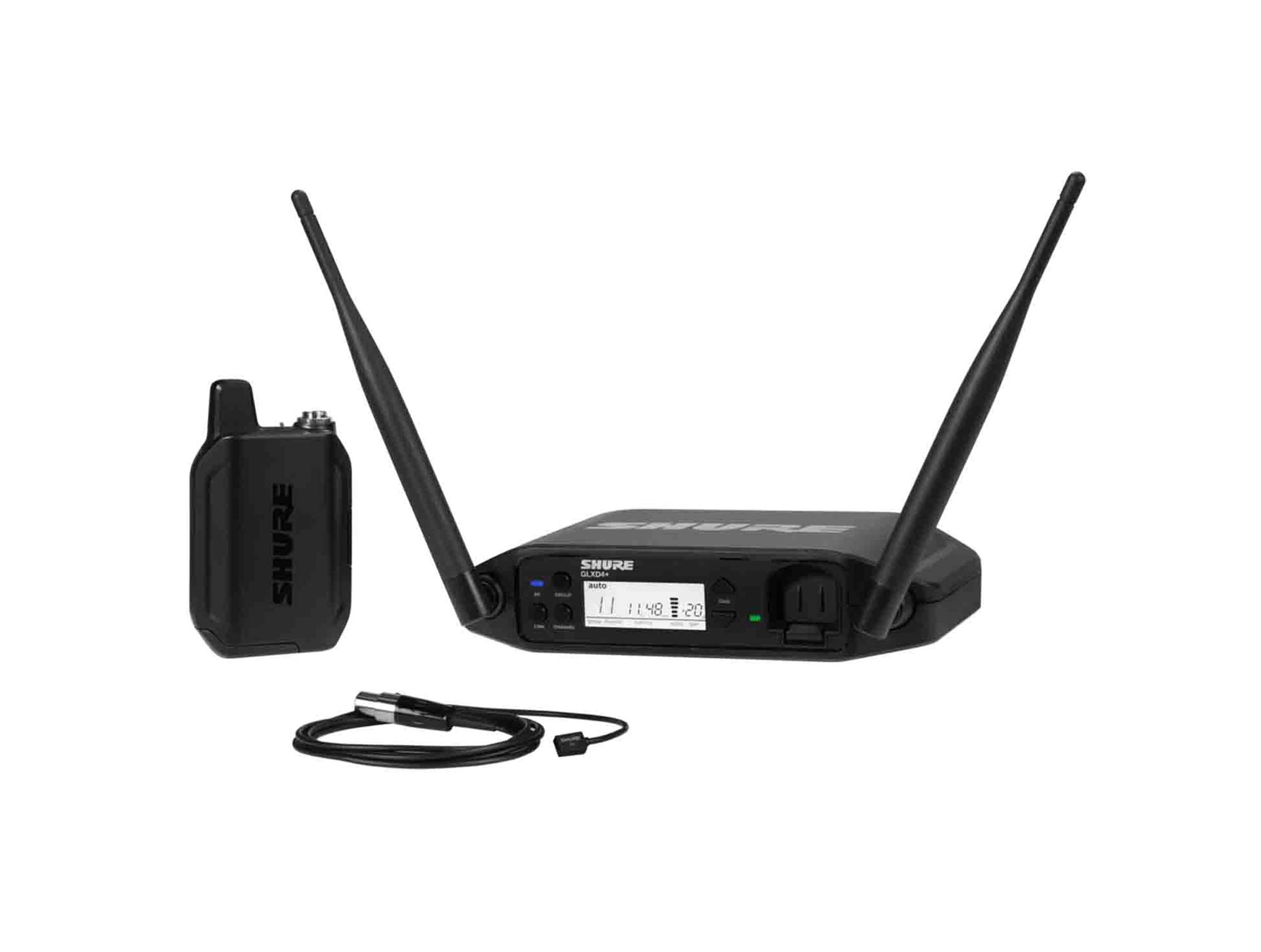




Shure GLX-D+ Dual Band Digital Wireless
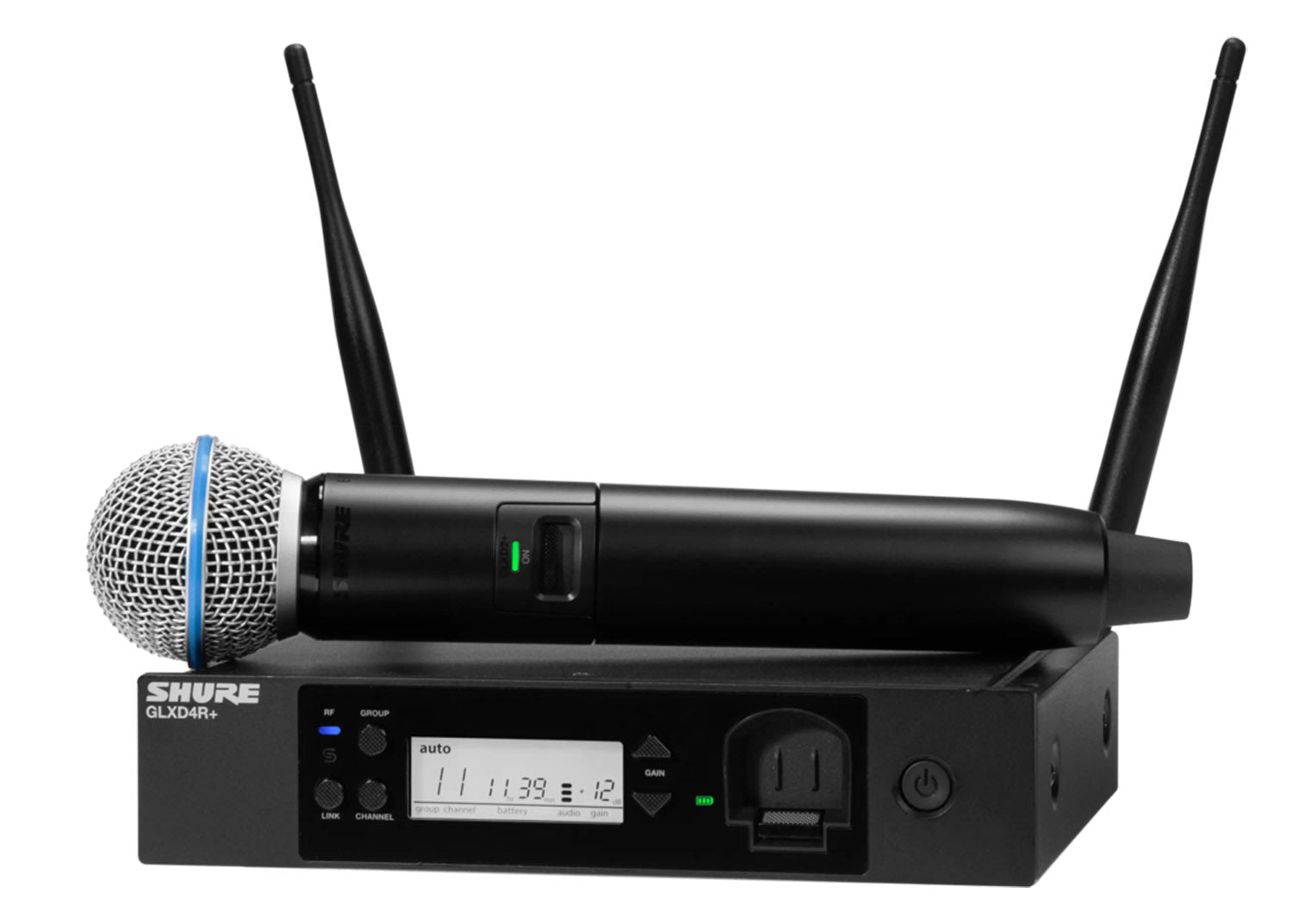
Shure GLX-D+ (GLXD+) is a license-free digital wireless system that works in both the 2.4 GHz and 5.8 GHz bands and picks the cleanest channel automatically. It suits presenters, houses of worship, bands and DJs. Choose a GLXD24+ handheld, headset, lavalier or GLXD16+ guitar pedal system, or a rack set with the GLXD4R+ half-rack receiver.
Not sure which GLX-D+ system you need? Read our buying guide ↓
Related categories: Shure SLX-D+, Shure BLX, Shure Wireless Microphones, All Wireless Microphones.
What is Shure GLX-D+?
GLX-D+ is Shure's dual-band digital wireless line: each system works in both the 2.4 GHz and 5.8 GHz bands, scans both, and moves to a clean channel automatically, without audio interruption. It is license-free, every transmitter runs on the same SB904 rechargeable lithium-ion battery, and Shure lists 20 Hz to 20 kHz frequency response and 120 dB (A-weighted) dynamic range. The original GLX-D worked in 2.4 GHz only; GLX-D+ adds the 5.8 GHz band, longer battery life and a built-in 1/4-inch guitar input.
Which GLX-D+ system should I buy for vocals, speech or guitar?
Match the transmitter to the job, then pick a receiver style.
- Singing and hosting: the GLXD24+ handheld system pairs the GLXD2+ transmitter with an SM58 or BETA 58A capsule. A GLXD2+/SM58 or GLXD2+/BETA 58A handheld is also sold on its own.
- Fitness, worship and hands-free speech: a GLXD14+ bodypack with a headset. Choose the SM35, SM31 or PGA31 headset, or the MX153 earset on the rack version.
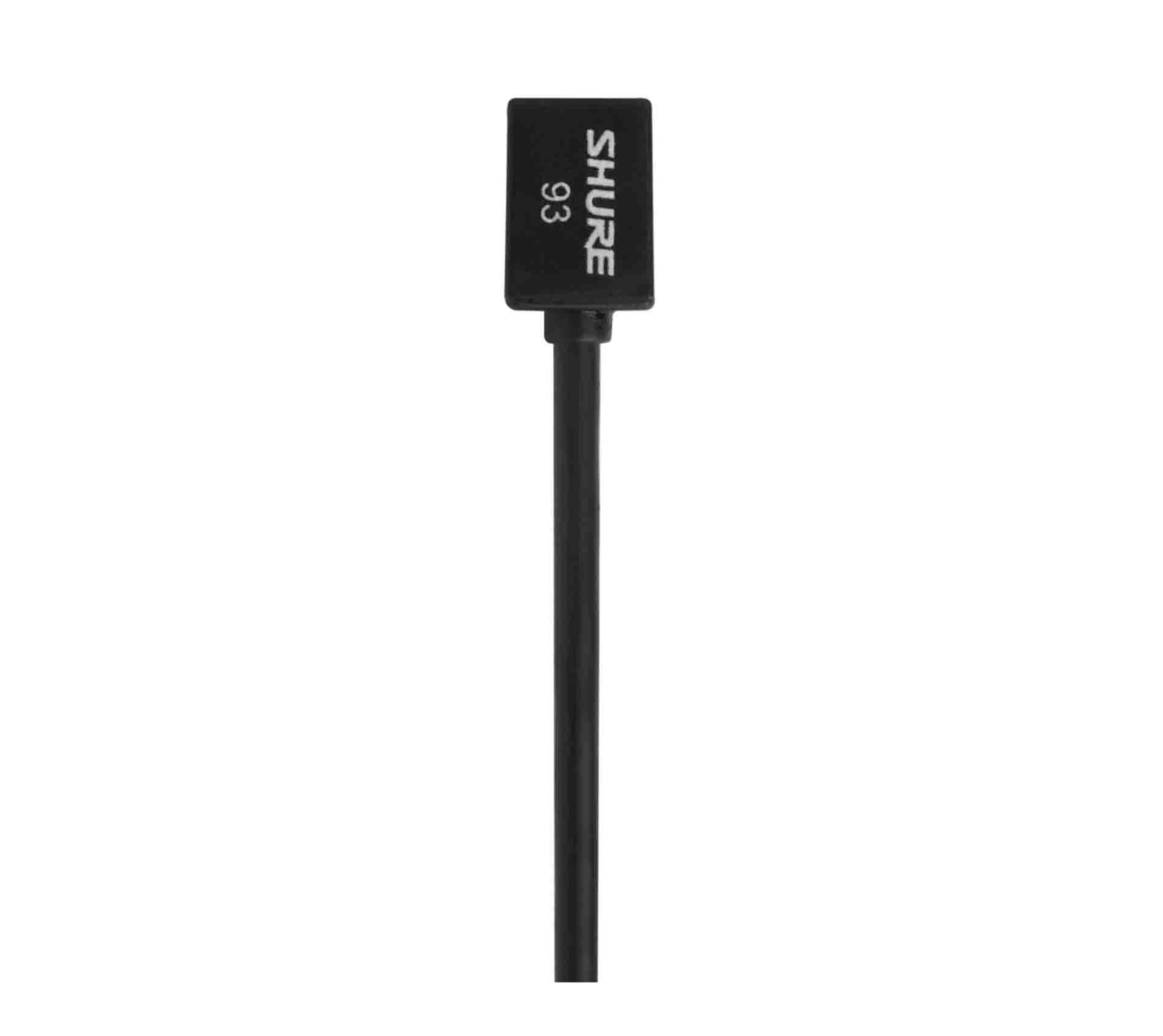
- Presentations and lectures: a GLXD14+ presenter system with a clip-on lavalier, either the WL93 or the WL185m.
- Horns and percussion: the GLXD14+/B98 instrument system with the BETA 98H clip-on gooseneck mic.
- Guitar and bass: the GLXD16+ guitar pedal system. Its GLXD6+ receiver sits on a pedalboard, has a built-in tuner and a true bypass 1/4-inch input, and runs from a 9V supply.
Should I get a rack receiver or the standard receiver?
Get a rack (R) system if you will run more than two systems at once or install them in a rack. Systems with an R in the name, such as the GLXD24R+ and GLXD14R+, use the GLXD4R+ half-rack receiver: 7.7 x 6.4 x 1.6 inches, 30.5 oz, with balanced XLR and 1/4-inch outputs and detachable antennas. Only the GLXD4R+ works with the GLX-D+ Frequency Manager. The non-rack GLXD14+ and GLXD24+ systems use the GLXD4+ tabletop receiver.
How many GLX-D+ systems can I use at the same time?
Up to 4 typical (8 in optimal conditions) without a frequency manager, and up to 11 typical (16 optimal) with one. Shure recommends the GLXD+FM Dual Band Frequency Manager for more than two receivers at once. One frequency manager links up to six GLXD4R+ receivers and powers them, and up to three can be daisy-chained to manage 16 receivers. These counts are for dual-band models such as the Z3 versions listed here.
How long does the GLX-D+ battery last?
Up to 11.5 hours per charge in Shure's specifications; Shure's product page rounds this to up to 12 hours. A 15-minute charge gives up to 1.5 hours, 30 minutes up to 3 hours, 1 hour up to 6 hours and a full 3-hour charge up to 11.5 hours (Shure's 5.8 GHz figures). The SB904 charges in the receiver's charging bay or over USB-C on the transmitter, and transmitters switch off after about 1 hour if they lose their receiver. Storage time and heat reduce runtime.
How is GLX-D+ different from Shure BLX and SLX-D+?
GLX-D+ is the rechargeable, dual-band option in the middle. BLX runs on a pair of AA batteries and works in a regional frequency band you choose at purchase. SLX-D+ is Shure's 24-bit digital system with a 138 MHz wide tuning range, lower latency and single, dual and quad receivers.
| Shure BLX | Shure GLX-D+ | Shure SLX-D+ | |
|---|---|---|---|
| Frequency band | One regional band, chosen at purchase | 2.4 GHz and 5.8 GHz, license-free | 138 MHz wide tuning range (region dependent) |
| Battery | 2 AA | SB904 rechargeable lithium-ion (included) | 2 AA (included) or optional SB903 rechargeable |
| Battery life | Up to 14 hours | Up to 11.5 hours (up to 12 on Shure's product page) | Up to 8 hours |
| Systems at once | Up to 12 per frequency band | Up to 4 typical, 8 optimal; up to 11 typical, 16 optimal with the frequency manager | Up to 11 in 6 MHz TV bands, up to 14 in 8 MHz TV bands |
| Latency | Not listed | 4.53 ms or 8 ms, depending on group | 2.8 ms |
| Receivers | Tabletop and rack | Tabletop, half-rack and guitar pedal | Half-rack single and dual, full-rack quad, portable |
How do I avoid Wi-Fi interference?
Keep the receiver at least 10 feet (3 meters) from Wi-Fi access points and computers, and keep transmitters more than 6 feet (2 meters) apart. Shure also recommends a clear line of sight between transmitter and receiver, placing the receiver on stage or at the top of the rack, turning on any Wi-Fi before scanning for a channel, and avoiding heavy Wi-Fi traffic such as large downloads during the show.
Can I buy extra GLX-D+ transmitters?
Yes. The GLXD1+ bodypack transmitter (4.5 x 2.6 x 1.1 inches, 5.4 oz without battery) and the GLXD2+ handheld transmitters are sold separately as spares or replacements. Both use the same SB904 battery.