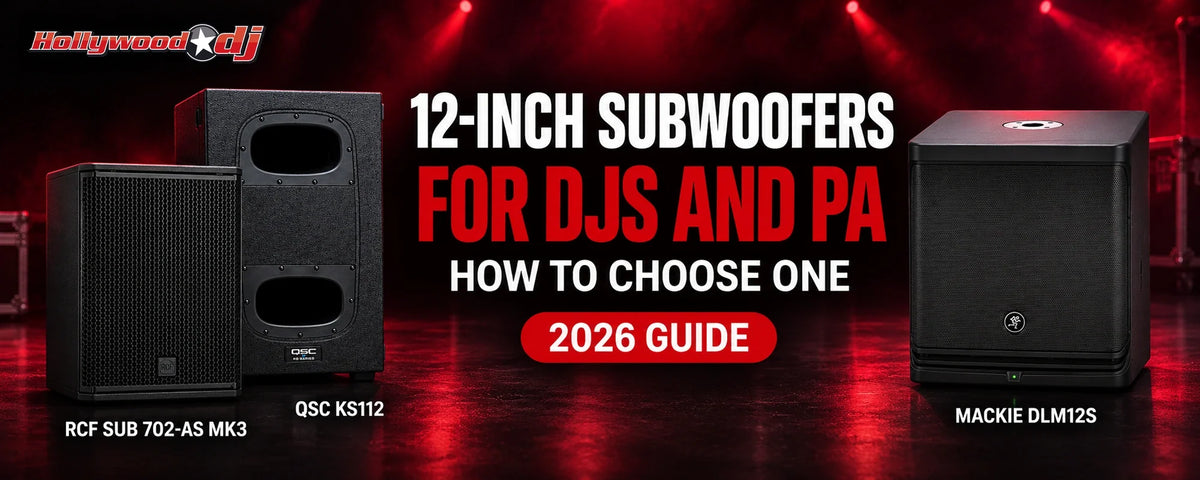
A 12-inch powered subwoofer is the usual first sub for a DJ, a small band or a bar. It is lighter and easier to carry than a 15 or 18, and it fills a small to mid-size room with clean low end. This guide is for PA and DJ subs, not car audio. We stock the RCF SUB 702-AS MK3 at $999, the Mackie DLM12S at $1,199.99, the QSC KS112 at $1,299.99 and the dB Technologies SUB 612 at $836. Prices are what we charge in November 2026, and specs come from the manufacturers.

12-inch powered subwoofers compared
| Model | Our price | Power | Good to know |
|---|---|---|---|
| dB Technologies SUB 612 | $836 | 600 W | Lowest price here, for small rooms and mobile sets |
| RCF SUB 702-AS MK3 | $999 | 1400 W peak, 700 W RMS | 129 dB max SPL, XLR in and out, built-in stereo crossover |
| Mackie DLM12S | $1,199.99 | 2000 W peak | 128 dB peak SPL, variable low-pass crossover (90 to 135 Hz), 48 lb |
| QSC KS112 | $1,299.99 | 2000 W Class D | Bandpass enclosure, 41 to 108 Hz at -6 dB, about 62 lb |
| QSC KS212C | $2,299.99 | 3,600 W | Dual 12-inch cardioid design that reduces bass behind the sub |
Should you buy a 12, 15 or 18-inch subwoofer?
A 12 is the easiest to carry and tends to sound tight and punchy. It does not go as low as a bigger sub. If your music has long sub-bass notes, or you play to a crowd larger than a small room, step up to a 15-inch or an 18-inch. If you are doing weddings, bars, house parties or speech and music, a 12 is a sensible place to start. See every size in 12-inch subwoofers and PA subwoofers.
Powered or passive?
A powered (active) sub has the amplifier and crossover built in. You plug in a signal and a power cord, and you are done. A passive sub needs a separate power amplifier and a crossover, which makes sense in a fixed install or when you already own amps. For a DJ who moves gear every weekend, powered is almost always the right call, and every sub in the table above is powered.
How to read the specs
- Peak vs RMS watts. Peak is a short burst. RMS is what it can sustain. The RCF lists both, 1400 W peak and 700 W RMS. When two subs show different numbers, check whether each is peak or RMS before comparing.
- Max SPL. This is how loud it gets at 1 meter. The RCF is rated at 129 dB and the Mackie at 128 dB. A few dB is a small difference to your ears, so do not choose on that number alone.
- Crossover. It decides which frequencies go to the sub and which go to your tops. The Mackie has a variable low-pass, 90 to 135 Hz, and the RCF has a built-in stereo crossover.
- Connections. You want a balanced XLR input. The RCF has two XLR inputs and two XLR outputs, so you can run a signal on through to your tops.
- Weight. You lift it into a car every gig. The Mackie is 48 lb and the QSC KS112 is about 62 lb.
New to the terms? Our pro audio terms glossary explains crossover, SPL, XLR and more.
Basic setup and placement
Put the sub on the floor, near the front of the room, between or under your speakers. Corners and walls make bass louder and boomier, so if it sounds muddy, move it away from the wall a few feet. Run your mixer or controller output into the sub, then run the sub's output on to your tops with a balanced cable. Our controller vs mixer guide covers what you need on the DJ side, and DJ speakers has tops to pair with a sub.
Common questions
Is a 12-inch subwoofer enough for a DJ?
For small rooms, house parties and most weddings, yes. For a larger crowd or heavy bass music, a 15 or 18-inch sub gives you more low end.
How many subwoofers do I need?
One is fine for a small room. Two give you more output and even coverage, and are the next step if one sub is not enough.
Powered or passive subwoofer for DJing?
Powered. The amplifier is built in, so setup is a cable and a power cord.
Do you sell car audio subwoofers?
No. These are PA and DJ subwoofers that plug into a power outlet.
Where should I put my subwoofer?
On the floor near the front of the room. Pull it a few feet from the wall if it sounds boomy.
Not sure what size or how many? Call 1-800-700-4542 and we will help you pick.